
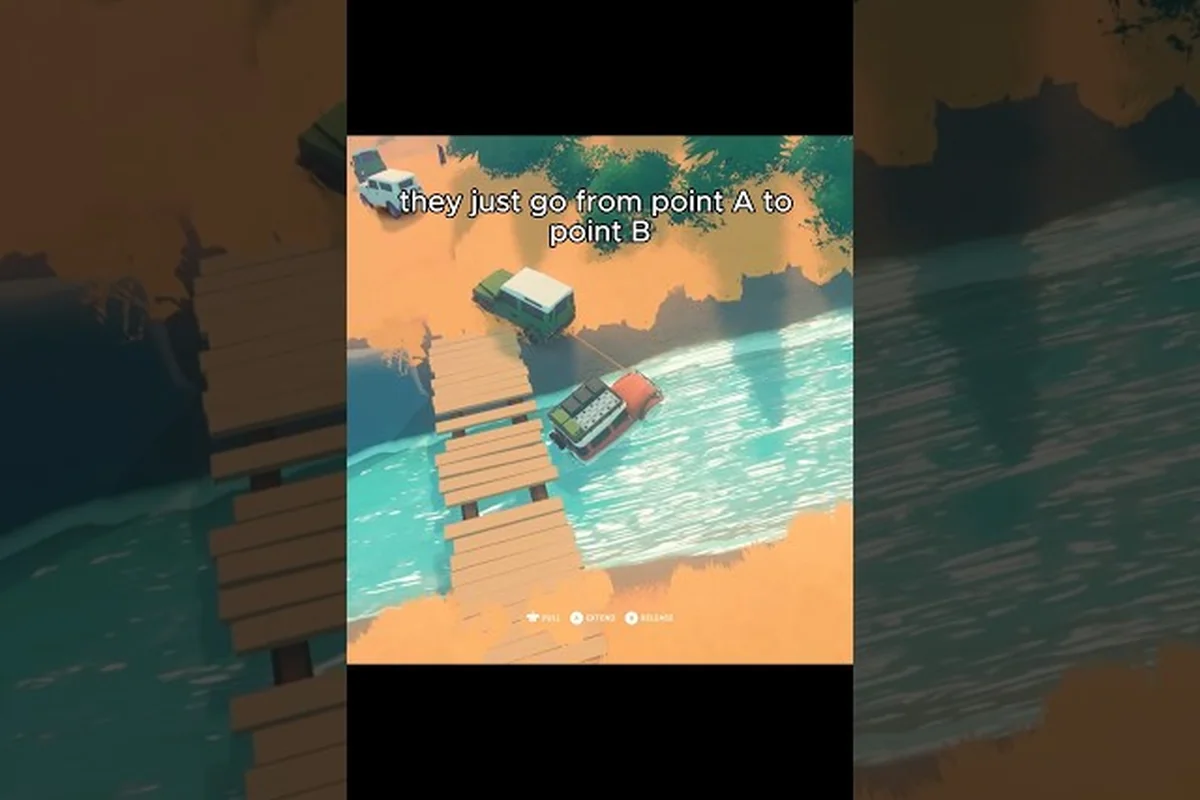
Over the Hill gives you no minimap blip and no checkpoint arrow, so the sun's position, the surface under your tires, and the way fog settles in low ground are the only navigation tools you get. This guide covers the cues that matter after dark, when the weather turns, and on ridgelines you have never driven before, so a wrong turn costs you minutes rather than a whole run.
Reading the Wilderness: Why Navigation Comes First in Over the Hill
Getting from one valley to the next in this game feels less like driving and more like orienting yourself in a quiet, oversized postcard. There is no minimap blip telling you which fork to take, and the route between two cabins can pass through three biomes before the cabin ever appears on the horizon. That is the entire point of the experience, and it is also the reason a solid grasp of navigation turns a frustrating afternoon into a genuinely relaxing drive.
This over the hill navigation guide exists because the game's terrain reads more like a real outdoor map than a typical racing line. You choose a direction, you watch the way the light falls on the hills, and you let the landscape itself tell you where the trail continues. Most players who bounce off the game in their first hour do so because they expect a GPS-grade wayfinder and a strict racing checkpoint structure. The actual design is closer to an open-country ramble: orientation, patience, and a handful of reliable cues beat raw speed every time.
The good news is that the tools you need are simple once you internalize them. Sun angle, road surface, the way fog gathers in low ground, and the way the wind sounds on the high passes all stack into a usable mental compass. Once you understand the over the hill weather guide principles layered on top, the world stops feeling ambiguous and starts feeling like a place you actually know.
Core Wayfinding Tools in Over the Hill
The game ships with a deliberately small set of navigation aids, and each one earns its place. There is no arrow overhead, no quest marker pinned to a flag, and no glowing objective tower. Instead, the developers give you compass readings, a hand-drawn style trail map that fills in as you explore, and a network of cabins and signposts that act as anchor points. The map updates organically when you physically pass a landmark, which means your mental model of the world grows in direct proportion to how much of it you have actually seen.
The Trail Map and Cabin Network
The cabin network is the single most important wayfinding feature in the game. According to the official over the hill on Steam store page, exploration and traversal are built around varied biomes inspired by real-world locations, with fast travel unlocked through discovered cabins. Each cabin you reach becomes a respawn point, a save anchor, and a fast-travel node. In practical terms, that means a wrong turn is never catastrophic as long as you have recently passed a cabin.
The trail map itself is not a real-time GPS. It shows terrain shading, the general path of the roads, and the cabins you have unlocked. It does not show your live position in the way a Google Maps overlay would. This forces you to triangulate using the compass and visible landmarks, which sounds inconvenient but is actually the entire appeal of the experience. If you want a deeper breakdown of how the map updates and how to read terrain shading, the over the hill beginner guide covers the first hour in more granular detail.
Compass, Headlights, and Cabin Beacons
Three secondary tools work quietly in the background. The compass gives you a stable bearing when the road bends out of sight, which is most useful in forested valleys where the sun disappears. Headlights are not just a visibility crutch for night driving; they also serve as a way to flag your position to yourself when the trail surface is hard to read. Cabin beacons glow softly at night and act as a homing signal when you are deciding whether to push on or cut your drive short.
| Tool | Primary Use | When It Shines | Limitation to Remember |
|---|---|---|---|
| Trail Map | Regional orientation | Planning a long route between valleys | No live position pin |
| Compass | Stable bearing | Forested valleys, fog, dawn light | Useless if you forget to glance at it |
| Headlights | Night visibility | Unlit trails after dusk | Drains focus, can wash out close terrain |
| Cabin Beacons | Homing signal | Late-evening drives | Only visible from a few hundred meters |
The Over the Hill Weather Guide Layer
Weather is the variable that most often makes a confident driver suddenly feel lost. The same hill you rolled over at noon can be invisible by the time a fog bank rolls in, and a stretch of gravel that felt grippy in dry conditions turns into a quiet skid under a thin layer of wet leaves. Treating weather as part of navigation, rather than as a cosmetic layer, is what separates drivers who finish trails from drivers who wander in circles.
Reading Fog, Rain, and Storm Cells
Fog is the single most disorienting condition in the game. It does not just lower visibility; it also dampens the sound of your engine, which removes the audio cue you usually rely on to know whether you are climbing or descending. When fog settles, switch to compass-led driving, slow down, and look for the darker patches on the road surface that signal a stream crossing. Those crossings almost always mark the lowest point in the local terrain, which means the road will climb on the other side and the trail will not dead-end.
Rain behaves differently. It rarely blocks sight lines completely, but it changes how the road responds. Painted lines and smooth asphalt become slick; gravel becomes oddly grippy until the first few cars have polished the surface. Storm cells are rarer and more dramatic, with visible lightning and a brief but intense downpour. According to the pinned over the hill FAQ thread on Steam, weather shifts are tied to in-game time and biome, which is why a coastal road at dusk feels wildly different from the same road at midday. Players have reported that storms tend to roll in from the west on most maps, so when the sky darkens over your right shoulder on a northbound trail, you usually have ten to fifteen minutes before visibility drops.
Seasonal and Time-of-Day Cues
Time of day is the quiet partner of weather. The same trail at 6 a.m. is a study in long blue shadows and crisp gravel sound, while the same trail at 7 p.m. is a wash of orange light and hard-to-read surfaces. Dawn and dusk are the most beautiful times to drive, but they are also the times when your depth perception compresses and small bumps feel larger than they are. Reserve the tricky switchbacks for full daylight, and use dawn and dusk for the stretches where you already know the line.
| Condition | Visibility Impact | Best Adjustment | Risk to Watch |
|---|---|---|---|
| Clear Day | Excellent | Standard pacing | Sun glare on east-facing climbs |
| Overcast | Very good | Ideal for new routes | Less terrain contrast in snow |
| Light Rain | Good | Lift off throttle early | Slick painted lines |
| Heavy Rain | Moderate | Follow the ruts | Hidden puddles in dips |
| Fog | Poor | Compass + slow speed | Losing the road entirely |
| Storm | Low, brief | Pull over if possible | Lightning + sudden drops |
The Over the Hill Night Driving Guide
Night driving is where the game stops being a casual ramble and turns into a meditation. The same trail you know by heart in daylight becomes a ribbon of headlight and engine sound, with only the cabin beacons and the moon to anchor your sense of direction. A good over the hill night driving guide is really a guide to trusting your instruments when your eyes run out of information.
Preparing for a Night Run
Preparation matters far more at night than during the day. Before you head out, confirm the next two cabins on your planned route and memorize the compass bearing between them. Fill up any visual aids, like a clean windshield and properly aimed headlights, because a small smear at 30 km/h is invisible but at 70 km/h is a wall of glare. Make sure you have already scouted the trickier sections in daylight, because trying to learn a new switchback at night is a reliable way to get stuck.
Audio becomes your primary sense at night. The way your engine tone changes on a climb is one of the most reliable cues in the entire game, and experienced drivers report that they can often feel a turn before they see it just from the road surface sound shifting under the tires. Players on the Steam Community Guides hub for over the hill have shared that the difference between a confident night driver and a hesitant one is almost entirely about listening to the road instead of staring into the headlights.
Handling Common Night Scenarios
Three scenarios come up repeatedly. The first is the open valley with no cabin in sight, which feels endless at night. The trick is to pick a single visual reference, like a distinctive tree line or a hillside silhouette, and steer toward it rather than trying to read the road surface. The second is the forest road, where the canopy blocks the moon and the headlights turn the world into a tunnel. In that case, drop your speed and use the road's painted edge as your only guide, trusting the compass for the actual direction. The third is the ridge road, where the sky is bright but the road is dark; here, the safest line is to aim for the center of the visible road and let the headlights find the edges, rather than hugging the shoulder and risking a drop-off.
For drivers who plan to spend long stretches away from the spawn cabin, the over the hill camping guide covers how the cassette player and weather tools interact with night drives, which is a natural companion to any serious night run.
| Scenario | Main Risk | Reliable Fix |
|---|---|---|
| Open valley, no cabin | Losing direction | Pick one silhouette, steer to it |
| Forest road, dark canopy | Tunnel vision | Use the painted edge, trust compass |
| Ridge road, bright sky | Misjudged drop-off | Aim for road center, let headlights find edges |
| Fog + night | Combined disorientation | Pull over, wait, do not push through |
Trail Strategy: Planning a Route You Can Actually Follow
A good route plan in this game is less about racing lines and more about the order in which you intend to visit known landmarks. Once you understand how the over the hill tutorial guide introduces the cabin network, the natural next step is to build personal routes that connect three or four cabins in a loop, with at least one backup option in case weather shifts mid-drive.
Building a Three-Cabin Loop
The cleanest first loop is a triangle of three cabins, each visible from the next on a clear day. Pick a starting cabin you have already unlocked, identify the next cabin roughly along one compass bearing, then turn at roughly sixty to ninety degrees toward a third cabin before closing the loop back to the start. On a clear day, this loop should take less than an hour and will give you a strong sense of the local terrain shading on the map. On a foggy day, the same loop becomes a compass exercise, and the fact that you already know the general shape of the triangle is what keeps you oriented.
According to community testing reported on the Steam reviews for over the hill, players who build at least one personal loop in their first few hours tend to rate the game more positively than players who treat every drive as an out-and-back from a single cabin. The reason is straightforward: loops teach you the shape of the land, while out-and-backs only teach you the shape of one road.
Recovery Tactics When You Are Lost
Even with planning, every driver eventually takes a wrong turn. The recovery tactics matter more than the planning because they are what keep a small mistake from becoming a long walk. First, stop the car. Do not keep driving while you are trying to read the map, because the map does not show your live position and you will end up guessing in the wrong place. Second, look at the sun or the brightest part of the sky. In the northern hemisphere biomes that dominate the game, the sun arcs through the south, so facing the brightest sky almost always points you toward a known direction on the compass. Third, look for water. Streams in this game almost always run downhill toward a larger body of water, and larger bodies of water are always near at least one cabin.
If you are still stuck, the most reliable tactic reported by experienced players is to follow any road downhill. Roads in the game are almost never built uphill into nowhere; they terminate at a cabin, a viewpoint, or a junction. The over the hill 100 percent completion guide includes a few challenge trail examples where this downhill rule is the only thing that keeps a long route from ending in a dead end.
| Recovery Step | What to Do | Why It Works |
|---|---|---|
| Stop the car | Park, do not creep | Stops compounding the wrong turn |
| Find the brightest sky | Face south in the northern biomes | Recovers a usable compass bearing |
| Look for water | Follow streams downhill | Water leads to cabins and junctions |
| Follow any road downhill | Trust the road network | Roads end at landmarks, not at nothing |
| Backtrack to last cabin | Reset your known map area | Cabin fast travel is the safety net |
Frequently Asked Questions
What is the fastest way to learn navigation in over the hill?
Build a three-cabin loop near your starting cabin and drive it in both directions. The loop teaches you terrain shading, compass bearings, and how the road surface changes with weather, all in under an hour. The official tutorial only introduces the basics, so a personal loop is what turns the over the hill tutorial guide into practical skill.
Does weather actually change the routes, or is it just visual?
Weather changes how the route feels and how your car responds, which is functionally a different route. Fog removes audio cues, rain changes grip on painted lines, and storms lower visibility dramatically. According to community data, storms tend to roll in from the west on most maps, so the over the hill weather guide rule of checking the western sky before a long drive is widely shared by experienced players.
Is night driving worth the risk for new players?
Yes, but only after you have driven the route once in daylight. Night driving is one of the most rewarding parts of the experience, and the cabin beacons plus the over the hill night driving guide basics (headlights aimed properly, compass checked often, audio trusted) make it safe. Trying to learn a brand new switchback at night, on the other hand, is the most common way new players get stuck.
Can I fast travel if I get truly lost?
Yes, fast travel is unlocked per cabin, and any cabin you have physically reached becomes a fast travel node. If you are lost and you know you passed a cabin within the last twenty minutes, your safest move is to backtrack to that cabin and use it as a reset point rather than pushing forward into unknown terrain. The over the hill guide covers how the cabin network interacts with exploration in more detail.
Do I need any specific vehicle or upgrade for better navigation?
No vehicle upgrade is required to navigate, but a few cosmetic and quality-of-life upgrades make night and weather driving much calmer. Players interested in how upgrades and weather tools interact with long drives will find the over the hill camping guide useful, since it covers weather tools, upgrade costs, and how the cassette player fits into a long touring setup.